Anger against the system exploded onto the streets. The fires and barricades could signal the end of this political regime if the movement keeps growing.

Anger against the system exploded onto the streets. The fires and barricades could signal the end of this political regime if the movement keeps growing.
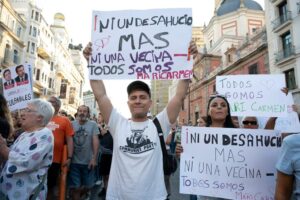
On Friday, 2 October 2026, the first result of the event that has shaken politics in the Spanish state was staged, with the vote in Congress of the two Decrees that the government had launched to try to respond to the housing movement. Both texts were negotiated in a hurry and represented the attempt of the ruling PSOE party and its allies to make a final move in order to survive the cycle that, inevitably, will open from the next few weeks.

It is quite likely that significant external pressure will be applied on Die Linke to form some sort of broad coalition to prevent the AfD from being in power. This would be somewhat similar to the popular front approach we saw in Spain in the 1930’s. While it is imperative to prevent the AfD from governing, Die Linke would be better off refraining from being part in such a coalition, precisely in order to shed the image of being just another Altpartei. That is the dilemma.

Given the victories of the nationalist parties, there is a real possibility of the break-up of the UK in the next few years which would pose huge changes to the structure of politics and society on the British Isles.

The war has not only destroyed Ukraine; it has seriously weakened the European economy, as the costs of production have rocketed with the loss of cheap energy imports from Russia.

On Saturday, September 13, well over 100,000 “Unite the Kingdom” anti-migrant protesters marched in London—vastly outnumbering (and surrounding) the counter-protest, which drew just 15,000. Here we reprint two articles from Counterfire, based in London, analyzing the urgent need for the left to mobilize and organize against the far-right.

Antonis Davanellos, a leading member of the Workers’ Left (DEA) in Greece, analyzes Tsipras’s betrayal and the consequences for the far left.

It is of outmost importance that these social processes from below can generate politics. These social processes should engage people who seek for a political expression and revitalize the political scene by shifting it to a radical left direction. We have past experience of such a process in Greece.

The people of Britain wanted to oust the Tories at any cost. In this regard, they cast a vote of hatred and disgust against the Tories rather than a vote of hope and optimism for Labour. The situation is the inevitable result of Tory policies over the last 14 years, which have desperately worsened the conditions of toiling Britons.

The far right has been pushed back by popular mobilization—now we must implement the program of the New Popular Front!

Starmer’s huge majority in parliament may give the illusion that he is running an all-powerful government, at least for a period. However, the election results reveal that the social basis for such a government is weak.

Strengthen the united and militant left, prevent the far right from coming to power!

The electoral success behind a banner that aspires to rescue a democracy kidnapped by the elites cannot be understood without assessing the democratic deficit of the societies in which it arises.

The far right is making serious gains across Europe. This is a threat that should not be taken lightly.

That the right-wing won the recent Dutch elections was no surprise. What was surprising was how decisive the share of the far-right was in the overall right-wing victory. For Geert Wilders, the leader of the far-right Freedom Party (PVV), years of patience paid off while the incumbent right-wing party gambled and lost.