Here we reprint an analysis from the socialist publication La Izquierda Diario originally published on the day after Lula’s October 25 reelection in Brazil. The International Socialist Project translated the original from Spanish. We have added some text to explain some references to Brazilian politics and history.
Three weeks ago, the election seemed like it was wrapped up. Flávio Bolsonaro won the first round with 47.03% of the vote against Lula’s 45.16%. The senator from the Bolsonaro clan, the heir apparent for his father, had become the candidate of an extreme right wing that remained powerful, even after four years “in the wilderness” after Lula ousted Jair Bolsonaro from the presidency. Moreover, Flávio sought to establish himself as a key pawn of the US and its “Shield of the Americas” initiative.
The final polls showed a dead heat, but Bolsonaro’s supporters were already getting ready to party. A sense of resignation, the kind that often comes with defeat, was settling in among much of progressive Brazil.
But on election night, everything turned around.
The most immediate explanation will be Lula’s charisma, the electoral weight of the Northeast, or Flávio Bolsonaro’s shortcomings as a candidate. All real factors. But there is another that is more important for understanding not only the result but also its future possibilities: the emergence of a popular mobilization that changed the dynamic and managed to win part of its agenda.
The “street”
Lula’s campaign entered the October 25 runoff on the defensive. For months, the government had focused on managing a center-left coalition and negotiating with conservative sectors. Meanwhile, Bolsonaro’s campaign capitalized on social discontent, leveraging a powerful digital machine (backed by Big Tech owners) and a right wing that never abandoned the streets.
The first round’s result forced a change in strategy. But the most important thing was that millions of Brazilians decided not to wait for instructions from the electoral high command.
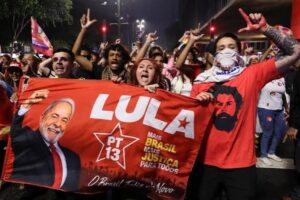
In the second week of October, protests multiplied across the country. On Sunday the 11th, a march stretched for twelve blocks along Avenida Paulista (the main boulevard of São Paulo, Brazil’s largest city). Solidarity actions took place in at least 76 other cities. Students organized assemblies, mobilizations, and campaigns at universities. Labor unions, social movements, fan clubs, and youth collectives joined in. In urban neighborhoods and outlying areas, marches and caravans multiplied.
Social media also played a key role. But its connection to grassroots mobilization marked a novel turn. The fight against Bolsonaro began to regain momentum when it stopped depending exclusively on cues from its leaders and transformed into a common project of broader sectors taking initiative.
And with the street protests came something even more important: the key points of a program. The end of the 6×1 work schedule (six days of work followed by one day of rest, the routine for millions of workers in business and services) moved to the center of the national debate. Five days’ work and two days rest. A basic demand, but enough to put the question of how to organize daily life in front of millions of people.
On October 14, the Senate approved the constitutional reform that ends the current system and gradually reduces the workweek from 44 to 40 hours, without a reduction in pay. The vote was 75 to 1. Two days later, the amendment passed.
It was a victory that social pressure forced. It was not a spontaneous concession from the Brazilian elite.
The mobilization wasn’t limited to defending Lula against Bolsonaro: it succeeded in shifting the political agenda toward workers’ demands. And that’s a crucial difference. It wasn’t only about winning votes to keep out the far right, but about demonstrating that popular struggle could change, even if only partially, the balance of forces. It achieved concrete results and had an impact on the elections.
The other ending
In 2011, as Lula left office with extraordinary approval ratings, Perry Anderson published an assessment of Lula’s administration in the London Review of Books that was both laudatory and critical. He considered Lula one of the most successful politicians of his time but pointed out a fundamental contradiction. Lula had improved the living conditions of millions of Brazilians without transforming that support into an active and organized popular force. The hallmark of his government, Anderson argued, had been demobilization.
Therein lay, according to the English Marxist, one of the limitations of Lula’s earlier terms: a degree of social redistribution without open confrontation with power structures, and a relationship with the popular sectors in which they appeared primarily as beneficiaries of public policies, rather than as actors determining their own destiny. More recently, this tendency has been taken to extremes, leading to an alliance with the traditional right wing, such as vice president Geraldo Alckmin, which has continued austerity and neoliberal policies implemented during the right-wing administration of Michel Temer (2016-2019), who took over after the right’s trumped-up impeachment of Dilma Rousseff, Lula’s successor.
The last few weeks have revealed a different possibility. Faced with the danger of the far right’s return, Lula’s social base did not simply wait for the government to solve their problems. They took to the streets, intervened, exerted pressure, and achieved a victory that would hardly have been possible if they had simply relied on normal parliamentary action: the end of the 6×1 law.
The danger
André Singer, one of the leading theorists of Lula’s camp, has been pointing out the contradictions of the coalition supporting the government. This “Concertación,” (agreement or pact) which unites Lula’s Workers Party with former adversaries from the PSDB (the center-right Brazilian Social Democracy Party), Alckmin, and sectors of the ruling class, contains, according to Singer, incompatible demands: fiscal austerity and the expansion of social spending. The result was a relatively paralyzed government, forced to constantly negotiate with the Centrão (i.e., “the Center,” the bloc of center-right parties in the national congress) and to contain its own initiatives within the limits of an economic policy that was always tailored to the demands of capital.
Those limits aren’t merely imposed on Lula. They also reflect a political decision by Lula himself, who once again prioritized agreements with sectors of the establishment as a guarantee of his ability to govern. This strategy allowed him to maintain his government, but it did not prevent the growth of the far right, much less resolve the social unrest that fuels it.
The mobilization in the leadup to the election showed that some gains can advance when the logic of permanent negotiation with those who oppose them is broken, even if only partially.
The risk now is that this social force will once again be treated as an emergency electoral resource. That social movements will retreat into their homes, that labor unions will return to the negotiating table, and that politics will once again be left in the hands of agreements between political parties and business factions.
The end of the 6×1 pay scale demonstrates what can be achieved through popular pressure. However, its effective implementation, the control of working conditions, and the defense of this gain against employers’ attempts to weaken it will also depend on continued mobilization.
Treating the election victory as a new mandate to manage class conciliation will aim to deactivate precisely the force that made the electoral recovery possible.
And therein lies the danger of a new demobilization: absorbing from above the demands that erupted from below, conceding what is indispensable to restore the balance and once again confining politics to the limits of what is possible or acceptable to capital.
If that happens, Bolsonarism will have new opportunities. The far right doesn’t disappear with an electoral defeat. It retains a social base, economic power, imperial backing, greater institutional influence, and the capacity to mobilize. And it can strengthen itself again if the expectations raised by this campaign clash with the usual constraints. That’s precisely what happened in these past four years.
A starting point
Lula’s victory prevented the return of an extreme right wing that posed a threat to democratic freedoms and workers’ rights. It also transformed the continent’s most important country into a key piece in the US imperial strategy for the region. But it also offered some clues as to how to confront it.
It wasn’t about defending institutions or forming a coalition that promised stability. It was necessary to regain the initiative, take to the streets, and put demands on the table that could involve millions.
The challenge now is to ensure that the social force that intervened in recent weeks does not become subordinated again to the timing and limitations of a government “tragically” conditioned by its internal makeup (the system of alliances that comprise it) and by the renewed strength that Bolsonarism won in Congress in the first round of elections.
The turnaround was possible because millions didn’t stay home. Their greatest achievement would be that they don’t return home after voting, so that others can write the last chapter.
Courtesy La Izquierda Diario